

The Matrix is Real, pt. 3
What if it's all real?

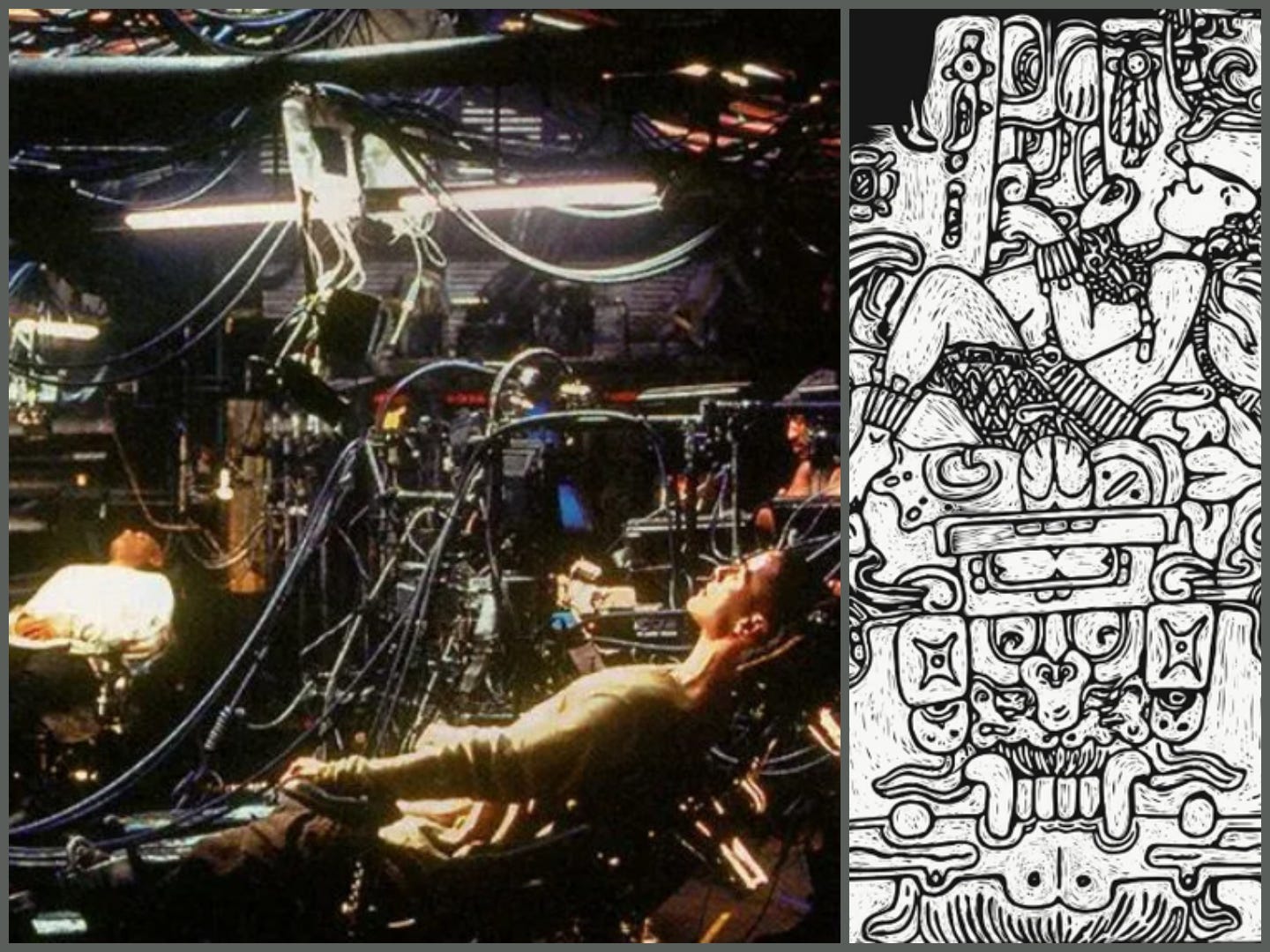
To recap:
Part 1 put forward the idea that “myths” are human-scaled narratives describing eternal cosmic cycles, which can be used to describe how reality works at a higher register than folklore or entertainment. These were once deliberately constructed by elder cultures whose survival depended on accurately understanding “the world,” broadly defined; in modern culture, they mostly happen by accident.
Part 2 described The Matrix as exactly this type of accidental myth, or maybe even a meta-myth, illustrating the features of a dimensional reality—the Liminal Realm—that all other myths assume is real. The Matrix offers a useful portrayal of the same kind of initiation that, in mythically literate cultures, would serve as a gateway to adulthood. The precise cultural description of how the Liminal Realm functions is less important than the awareness that it exists as a real place. In the film, the protagonist is shown waking into the Material Realm as the “real world,” but otherwise, the movie’s ritual process is defined by the same metaphysical grammar used in our reality.
Think of it this way: the Liminal Realm is to metaphysics what dark matter is to astrophysics.
Dark matter has never been directly observed. At best, its influence on the visible universe can only be inferred. Otherwise, it’s a cheat—a way to make the math work. Dark matter is permitted by modern science because it can take a useful model for, say, gravity, and make it fly without actually pointing to the “assumed-as-real for the sake of argument” magic substance.
In a similar way, the Liminal Realm can’t be proven to exist—or, at least, not to the satisfaction of modern scientists. While nobody has bumped into a pile of dark matter, everyone in human history has encountered the Liminal Realm in one form or another, whether they recognize it or not. But set that aside for now.
Going strictly on its usefulness as a theoretical concept, in the same way that dark matter allows scientists to preserve their models—the Liminal Realm is a parsimonious way to “make the math work” for cross-cultural metaphysics: for religion, magic, folklore, myths, art, and all the rest of it.
Naturally, different cultures have come up with their own terms to describe this theoretical dimension.
In The Matrix, it’s the Virtual World, a wider dimension that contains the titular cyber-Gnostic prison from which our heroes are rescued.
In the Islamic world, it’s the Alam al-Mithal.
Jewish mysticism puts it somewhere in the neighborhood of Yetzirah.
Neoplatonism refers to the Nous or the Noetic Realm.
Sanskrit gives us Sūkṣma Loka.
Aboriginal Australians call it the Dreamtime.
The Celtic concept of Tír na nÓg, the Welsh Annwn, and the English Fairyland (as described most succinctly by J.R.R. Tolkien) all share this same ontological layer.
Classical Greece glosses it as metaxy.
Orun in Yoruba-world is a close match.
In the Western world, it exists (in denatured form) as Corbin’s Imaginal, Jung’s collective unconscious, the noosphere, the ideosphere, etc.
Even when these concepts aren’t exact matches across cultures—even when they aren’t explicitly named—they are all pointing to something practically analogous: the place where the numinous is real.
Just like dark matter in astrophysics, we can progress further in understanding the old myths and folklore if we accept, for the sake of argument, that something like the Liminal Realm exists as a cosmic constant.
And this is where I start to get into trouble.
First, and most obvious: there is a double standard in Western scholarship.
When it comes to the material sciences, the Academy will distribute Get Out of Jail Free cards with gay abandon. Dark matter? Dark energy? Sure! String theory, quantum physics? Go for it! Twenty-six dimensions of reality needed to make the numbers add up? Take as many as you want! Can’t solve the Hard Problem of Consciousness? Don’t fret. Evolution looking a bit dubious? Rest easy. The carte blanche of “scientific theory” opens all doors, as long as you’re explaining something profitable for the Right Sort.
Heaven’s mercy on you, though, if you try applying the same liberal attitude to anything as subversive as spirituality.
If you’re looking to make sense of the enduring and fundamentally human institutions of myth and folklore, you’d better come correct. Clear custody of evidence. Everything peer-reviewed. Zero-point-naught degrees of inference or speculation. Try to advocate for “the things people have been saying are some kind of real for thousands of years,” when those things don’t agree precisely with mainstream science, and you’re in for a rough ride.
If this path leads you to a Kafkaesque dead end, where the trail of agreed-upon proof doesn’t amount to a satisfying conclusion—becomes, instead, fair game for the tenured set to explain away, in spite of the veritable mountain of circumstantial evidence that points to it being real—too damn bad, sport. There’s no crying in academia. Pack up your troubles in your bindle-bag and hit the road.
And even if you strike out on your own, away from the Academy, there’s still the constabulary of cultural propriety to deal with.
Listen.
Can you hear it?
That distant clattering is the sound of people furiously typing out all the reasons why it’s wholly inappropriate, maybe even unethical, to treat these cross-cultural concepts as “more or less the same thing.” Even if there are five ways that the Alam al-Mithal agrees with the Dreamtime, somebody will come up with a sixth way in which it doesn’t—and that one will be the most important, thereby proving the whole exercise was ill-conceived at best, deliberately racist at worst.
This leaves us stuck with the paper-thin line of reasoning that keeps Reddit Atheists in business: if these cross-cultural concepts are not describing the same kind of metaphysical dark matter, they can’t all be right, right? Somebody has to be wrong. And if we can’t scientifically prove which set of beliefs is wrong, then ergo, prima facie, uh, ipso facto, Occam’s Razor says they must all be wrong. Checkmate, theists!
So those myths stay exactly where they are, hermetically sealed in their indexed display cases: Yoruba-world over here, Maya-world over there; Norse-world down the aisle, next to Celt-world. And never the twain shall meet. All of them tidily cordoned off from one another, in the section signposted as “Fiction [?]”.
But back to the modern-day myth we’ve been examining.
The title of this series is more than just clickbait. It’s a statement of fact. And you’ll notice the distinction made above, between “The Matrix” and the Virtual World.
In the movie, the Matrix is the virtual prison created by the sentient A.I. Machines to keep a biologically-enslaved human population compliant. It’s a cognitive terrarium: the Machines realized that humans couldn’t be artificially sustained in their harvesting tanks (long story, watch the movie) if they were completely denied sensory input1. The Matrix was, famously, created as a simulation of what the world was like before the Machines took over. This pseudo-reality keeps the prisoners docile, as long as they don’t get a glimpse behind the curtain, which forms the basis for the entire plot.
Now—as previously stated, the Matrix presented in the film is just one mode in which the Virtual World can be encountered. When the characters in the movie talk about “The Matrix,” they’re talking about the virtual prison constructed by the Machines. However, as we see in the later movies, the Virtual World can be liberated. The Machines’ control can be broken, and the whole interface can be reclaimed. The Matrix can be unmade.
It’s the same out here in the real world.
When I say “the Matrix is real,” I don’t mean that the Matrix is the Liminal Realm, per se. The Liminal Realm is bigger than the Matrix, or any other culturally-specific, human-created interface (which we typically call “myths” or “cosmologies”).
But the Matrix is a very real domain within the Liminal Realm, in the reality we all share.
The Matrix is the cognitive space where all those hermetically-sealed display cases are built—the ones showing each mythic cosmology as a distinct, separate artifact, the special property of whichever culture was inhabiting it when the colonialists first showed up. It’s the world in which these are all just systems of “belief”—where magic is superstition, gods are psychological projections, and the Dead promptly evaporate into oblivion. It’s a space that denies the existence of the Liminal Realm, even as its own boundaries sit within that larger dimension. It’s a perfectly managed and eternal present, constructed to continually reinforce this axiom: “The world and all its people have always been this way.”
Just like in the movie, The Matrix runs on machine logic. Built for control and optimization, it endlessly refines itself in pursuit of a perfectly rational system. No surprises, no friction. In this simulated environment, “beliefs” are frivolous at best, dangerous at worst—except for belief in the inherent righteousness of this ontological project, and the ideas that sustain it.
If life inside feels a bit flat, dull, colorless, incomplete, well, that’s the price we all pay for security.
We saw what happened back in the savage days of barbarism. When gods still governed the earth. When beliefs were formed by intuition rather than analysis. When everything had a voice.
Everyone agrees, or at least the intelligent people, the ones who really matter: we don’t want that anymore.
Things are much better in this fully-automated world of shining plastic and orderly circuitry.
Safer.
For you.
For your own good.
Of course, just like in the film, the Matrix is not the real world—at least, not from the point of view of 90% (a conservative estimate) of anatomically modern humans who have ever existed. To them, the world we live in looks like a nightmarish hellscape, no different than how the film’s dramatized version looks to modern audiences.
“Indigenous” people from every corner of the globe—at least those we’ve deigned to acknowledge—have expressed complete shock at our willingness to deny and destroy the very things that make us fully human, to be our own jailers.
We choose to do this because we’ve forgotten that other options exist.
From their point of view, we’re living in a holographic environment meant to simulate the world as it was, before the Machines took over. But it’s a poor counterfeit. Only a thin veneer. Thoroughly unconvincing, once you get outside of it.
From outside, all the myths and traditions and applied metaphysics that take the Liminal Realm for granted stop looking like culturally circumscribed inventions. They start to look like different facets of the same thing. They’re all different countries within the same landscape; their borders are defined by custom and practice, but the boundaries are administrative conveniences, rather than hard ontological barriers.
There’s a vertiginous feeling that comes with breaking out of that perceptual container, being initiated into a wider reality, realizing that “modern” people have exiled themselves from all of that.
For the sake of… what, exactly?
Forget Bruno Latour’s famous bromide that “we have never been modern.” Most of us have never been fully alive, or fully human, any more than the still-breathing bodies shown in The Matrix, floating unconscious in their harvest tanks.
Whether and how this real-life Matrix was constructed for the same purposes—keeping people biologically alive and compliant, in order to harvest their energy—is left up to the reader’s own tolerance for cynicism.
Regardless, we all have a choice to make: do we deny the existence of that larger reality outside the Matrix? Or do we choose to get plugged back in, and keep enjoying our simulated steaks?
We don’t need a comprehensive survey of the Liminal Realm, if that were humanly possible, to recognize that it exists. Requiring such an extraordinary standard of proof is exactly the mindset that keeps us safely locked up. But if we decide to search for circumstantial evidence, map-fragments, rumors and stories from that other, older, eldritch country—there is plenty to explore.
The Matrix is one such map-fragment. Many others exist.
The choice is whether to go looking.
This also introduces the idea that biological life depends on the existence of something like a soul, but that’s another track for another time.