

The Matrix is Real, pt. 2
Which world do you want to live in?

You can read Part 1 here, as well as over at my Patreon, where the current essay will also be published.
Let’s accept for the sake of argument that The Matrix is one of those accidentally mythic movies described in Part 1.
If that’s true, we should be able to read it as a map, instead of looking at it like a cinematic landscape painting.
What does this theoretical map tell us?
Follow me close here, and don’t get too distracted by the sci-fi elements added to the movie for entertainment’s sake.
The world of the movie presents us with a threefold cosmos. It will be easier to think of these as stratified layers. There is the Code World on top; the Real World on the bottom; the Virtual World sandwiched between them.
Keep in mind that only one of those layers—the Real World—has physical volume; the other two are five-dimensional spaces.
In the Virtual World, the familiar dimensions of the Real World are simulated. The illusion of three-dimensional space and time is generated as an interface for human users. Those dimensions are not fundamental parts of the Virtual World, but have been added for the sake of interoperability.
We’re introduced to human characters in the Real World who are literate enough to “see” the forms that the code represents, just by reading the cascade of numbers on their monitors.
At the end of the movie, we get a glimpse of what the Virtual World looks like without this layer of perceptual convenience: a flowing river of code that shapes the artificial environment of the interface.
Neo, the protagonist, will eventually learn to see the code without the monitors, from within the Virtual World; when he no longer recognizes the reality of that surface layer, he’s able to manipulate the underlying code at will, bending the artificial environment around him.
Crucially, however—the code these characters see and interact with is not the form of ultimate reality.
“You get used to it… I don’t even see the code anymore, i just see ‘blonde,’ ‘brunette,’ ‘redhead’”... - Joe Pantoliano as “Cypher” in The Matrix, 1999.
While the simulated environment of the Virtual World is a contrived affordance for human users (and, by extension, the audience), the code itself is the same kind of artificial construct. The numbers that Cypher views on his monitor from outside, and the cascade of code that Neo eventually learns to see all around him from inside—these are just graphic representations of something much subtler.
The Code World exists behind the ones and zeroes.
It shapes the Virtual World in ways that are hard to describe, through processes that are ineffable, nonrepresentational, indescribable within the constraints of human language. The Code World operates on something that can only be traced, in the crudest sense, as Patterns—but patterns unbound by spatial dimension or linear time. Pure information. Practically impossible for humans to visualize or understand, beyond any frame of reference we can imagine.
To paraphrase the old masters: the Code World that can be defined is not the true Code World.
The movie struggles to explain exactly how the Virtual World emerged from the Code World. Who wrote the original code? Who first created the Virtual World? Who established the rules on which all other rules are based? Who decided it would be possible, let alone useful, for the Virtual World to serve as a human-scaled interface in the first place?
More importantly—if the Code World is a realm of pure information, never-not-always-already unfolding—does it even make sense to talk about the Virtual World as the creation of a single identifiable creator?
Did the Code World first manifest itself as a non-objective sense of rightness or coherence in the imagination of whoever laid the foundations for the Virtual World?
And does that make the individual architect a creator, ex nihilo, or simply a conduit?
“Whoa.” - Keanu Reeves as “Neo,” The Matrix, 1999.
This same paradox is true for the filmmakers themselves. As described in Part 1, the Wachowskis undoubtedly did a tremendous job of illustrating this threefold cosmos for modern audiences. But the ancient myths got there first, and arguably did it better.
So who really created what, and when?
If there was a mythic form that inspired The Matrix—or any other modern-day epic—and that myth was the invention of an individual human, how far back in our history do we go looking for the person who first inspired them, who first inspired them, who first inspired them?
What if there’s not an identifiable individual on the other end of that chain at all?
What if we followed it all the way back 100,000 years—to the time these archetypal myths were first formulated as causal narratives, told in a human voice for the first time—and still couldn’t nail down exactly where it truly originated?
But the bigger question is this: why should anybody in the modern world care?
This all starts to sound like one-hand-clapping nonsense to modern people. Clever word-games. Cinematic stage magic tarted up with a layer of pretentious pop philosophy.
What does it have to do with the practical business of living in the Real World?
You might say we all have a choice to make, once we’re presented with this information.
“All I’m offering is the truth.” - Laurence Fishburne as “Morpheus,” The Matrix, 1999.
This is why it’s such a monumental crime that The Matrix has been mulched up into an idiotic meme.
Referencing the scene described below, people of all political persuasions now claim that to be “red pilled” is to hold an ideological position that they agree with. In order for that metaphor to work, all the consequential choices about how we perceive reality must be contained within the mundane world—which violates both the logic of the original metaphor and aeons of human imagination.
These people are holding up a bath toy and claiming it’s an ocean liner.
Pay no mind.
Back to the myth within the movie.
For our purposes, the most important scene takes place after our hero follows a trail of synchronicities and mysterious guides, and finally gets a meeting with the illusive Morpheus.
On the surface, this could serve as an allegory for any kind of personal awakening. The creators of the film probably had one kind of realization in mind. The crayon-eating denizens of social media have obviously done their own exegesis on what enlightenment really means.
But a mythic reading of the movie would say that allegory is superfluous. The choice that Morpheus gives Neo is exactly the choice presented to people in elder cultures since time immemorial. Not as a portal to some superhuman transcendence, but at the threshold of the first opportunity to become fully human—the transition from childhood to adulthood. The most elemental form of ritual initiation.
And again, no allegorical reading is needed.
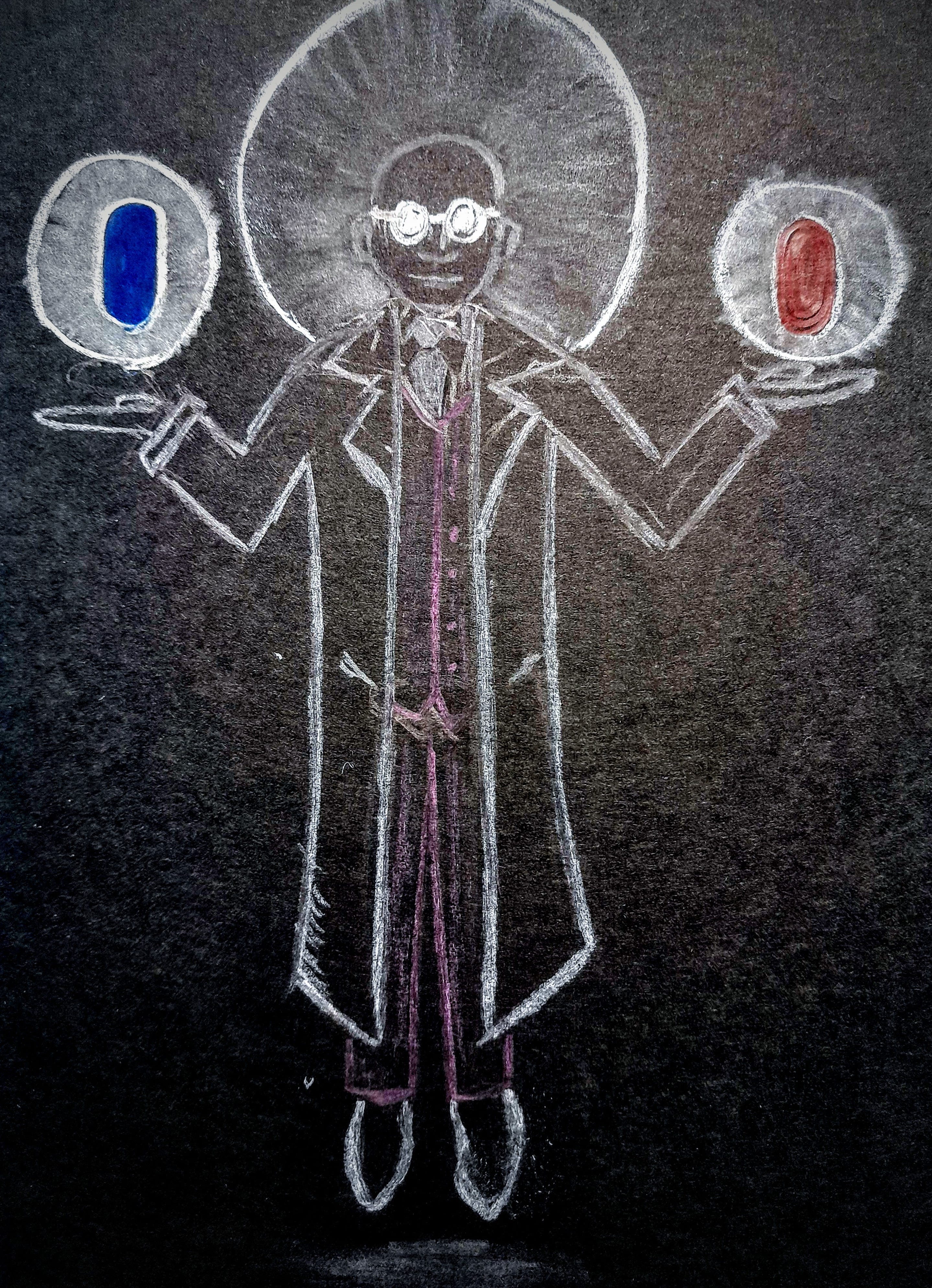
Morpheus (named after the Greek god of dreams, one of the mythic gatekeepers for the Imaginal Realm) offers the neophyte a choice in the form of two pills. The red pill allows Neo to see the world as it truly is. This will strip away the comfortable forms that kept him safe while his identity cohered, allowing him to realize his place within a much wider and more dangerous reality than the nursery-rhyme version he grew up with. The blue pill will keep him in a childlike state of dependence within the world of illusions.
This is the same choice offered to adolescents in ritually competent cultures from one end of the globe to the other, according to the same logic and carrying the same risks.
“Unfortunately, no one can tell you what the Matrix is. You have to see it for yourself.” - Laurence Fishburne as “Morpheus,” The Matrix, 1999.
This is pure, unvarnished shamanic logic. You can’t be told what “it” is, because the “you” trying to interpret an abstract description is not the “you” that will have to live in—and with—that post-initiatory reality. The entire point of initiation is to break the customary frame of reference used for interpretation of any kind.
Elder cultures have used a variety of techniques to engineer this breakthrough. Wilderness rites. Physical deprivation. Self-mortification. Symbolic death and resurrection. Entheogenic plant-medicines of all descriptions.
Just as in the film, the process is painful and dangerous for the initiate. The movie condenses this part of the ritual into a hallucinatory near-death experience, sanitized for modern audiences by staging it within the Virtual World. But the dramatization is accurate: in order to see, the self that cocooned the developing mind has to be ripped away, through a process of mediated trauma.
The self that believed in the world of appearances has to die.
From here, the diegetic world of the movie inverts the actual journey of real-life initiates, with Neo breaking out of the Virtual World and waking into the Real World.
In our reality, it’s the opposite: initiation brings the candidate out of the Material Realm and into the Liminal Realm—the world of gods and monsters, spirits and demons.
Where the real action happens.
It’s important to underscore that this is not a metaphorical process. In elder cultures, initiation is not a purely intellectual transformation, as it is in the modern world. If the ritual is properly accomplished, initiates will viscerally experience something that would previously have seemed impossible. Whether that’s death without oblivion, trauma without erasure, or full-on psychedelia—these breakthroughs are much more ontologically robust than becoming aware of the “adult world” in a mundane sense.
In these cultures, you get to smoke and drink and swear with the grown-ups after you see the Others, and demonstrate that you can be trusted not to lose your shit completely.
But this is also more than an over-dramatic hazing ritual—not “we all get to be members of the club because we were all peer-pressured into tripping our faces off.”
Initiation is confirmation.
The ritual should verify the reality of the cosmology that the initiate had previously encountered, as second-hand folklore, throughout their adolescence. With the correct cultural preparation, someone encountering the Liminal Realm for the first time should recognize it as an actual geography. This is where the medicine-people go to bring back healing. This is where the seers read the hoofprints of fate. This is where Divine Law is realized—where new souls come from, where the Dead travel, where the gods who inspire consciousness have their halls.
This is succinctly dramatized in the film, albeit as a poorly-constructed ritual. The necessity of the plot dictates that Neo must not have the mythic framework described to him before his ordeal. There is no folklore to prepare him for what he will experience.
He’s heard rumors about The Matrix, but for maximum dramatic effect, nobody tells him what to expect before he takes the Red Pill. As a result, the initiation plays out like a bad acid trip. Neo almost goes into cardiac arrest as the medicine takes hold. He wakes up in the “real world” as a terrified newborn, and almost dies again. Nevertheless, he is rescued, recovers, and finally takes his place among the other adult adepts, having survived his ordeal.
Interesting interpretive move, modern critics might say. Another allegory for adulthood. Stupendous. But what makes The Matrix different from any other Hero’s Journey?
Check it out:
The Virtual World dramatized in the movie operates on exactly the same logic as the Liminal Realm, as described in countless mythic traditions. Underneath the cultural trappings of cosmologies from around the world, there is something like the same threefold cosmos. There is the Material Realm where we live; there is the Divine Realm that orders the cosmos, according to principles that defy human interpretation; and in between the two, as a mediated interface, is the Liminal Realm.
Just like in the film, the two metaphysical realms are five-dimensional spaces; just like in the film, the mediating layer is where ineffable Patterns become recognizable shapes, and emerge as personalities.
Human consciousness can’t directly apprehend the Divine Realm without suffering a Lovecraftian psychic implosion. Nevertheless, the Divine Realm can come to us, via the Liminal Realm, at smaller scale and with limited expression. Seers have encountered the forms of Liminal entities who give voice to Divine Patterns at a tolerable volume.
These are no different than the program-avatars who populate the Virtual World in the Matrix—except that they’re real.
By all accounts, the Liminal Realm is a recognizable space. But the rules are different there. Time moves strangely. Space warps. Even the gods aren’t fully in control. Skillful operators have learned to bend the rules in ways that precipitate miracles out here in the mundane world. There is a cost, though: the psychic tolls of journeying too far or falling foul of the wrong powers can have lasting physical consequences, for both the traveler and the world.
Modern scholarship has cynically focused on the superficial differences between these mythic narratives. For materialists, it’s easy to dismiss these cultural contingencies as proof that there is no underlying reality. That it’s all pure invention.
But the specificity and consistency with which the Liminal Realm is described in the myths—if not in exact appearance, then in overall topography—is too hard to ignore or rationalize.
The choice held out by the myths, balanced on two outstretched palms, is this: do we choose to believe the old stories describing the Liminal Realm as a real place, telling us that to be fully human is to recognize our connection with it?
If not, we could choose to continue treating that multitude of sustained, detailed, cross-cultural accounts as different expressions of the same crude superstition. Manufactured escapism for primitive people. No different than our own modern fairy stories.
You get to choose. Everybody does.
Awareness of the choice is not the initiation. Being presented with the choice only marks you as a candidate. You still have to pop one of the pills in your mouth, take the journey, and see what’s left of you on the other side.
You take the blue pill, the story ends. You wake up in your bed and believe whatever you want to believe, safe in the knowledge that none of this is really real. You take the red pill, you stay in Wonderland, where all the world’s myths are some kind of real, and find out just how deep the rabbit hole goes.
Aye! I just detoured this way out of light curiosity sparked by talk of The Matrix in 2026. Achah?? Best commentary I've read - biased in so far as being on count of matching my internal own, but yes, and....i know its a crowded cliche..but, timing. I was just casually reading a kind of myth-poetic passage on Pythagoras this morning - yesterday, and struck briefly dumb by description of the 'river of number' 'lightning flash' seed-experience for all his subsequent activity. So far as one could say then, would appear bizarrely consistent since C6th b.c at least - though in alignment with your comment on the failure of representation, resonant more by suggestive, precise essential features and affect than literal or full description. Very curious, nicely written also btw.