

Ghosts of the Present
On the merits of grinching, and minding the darkness.

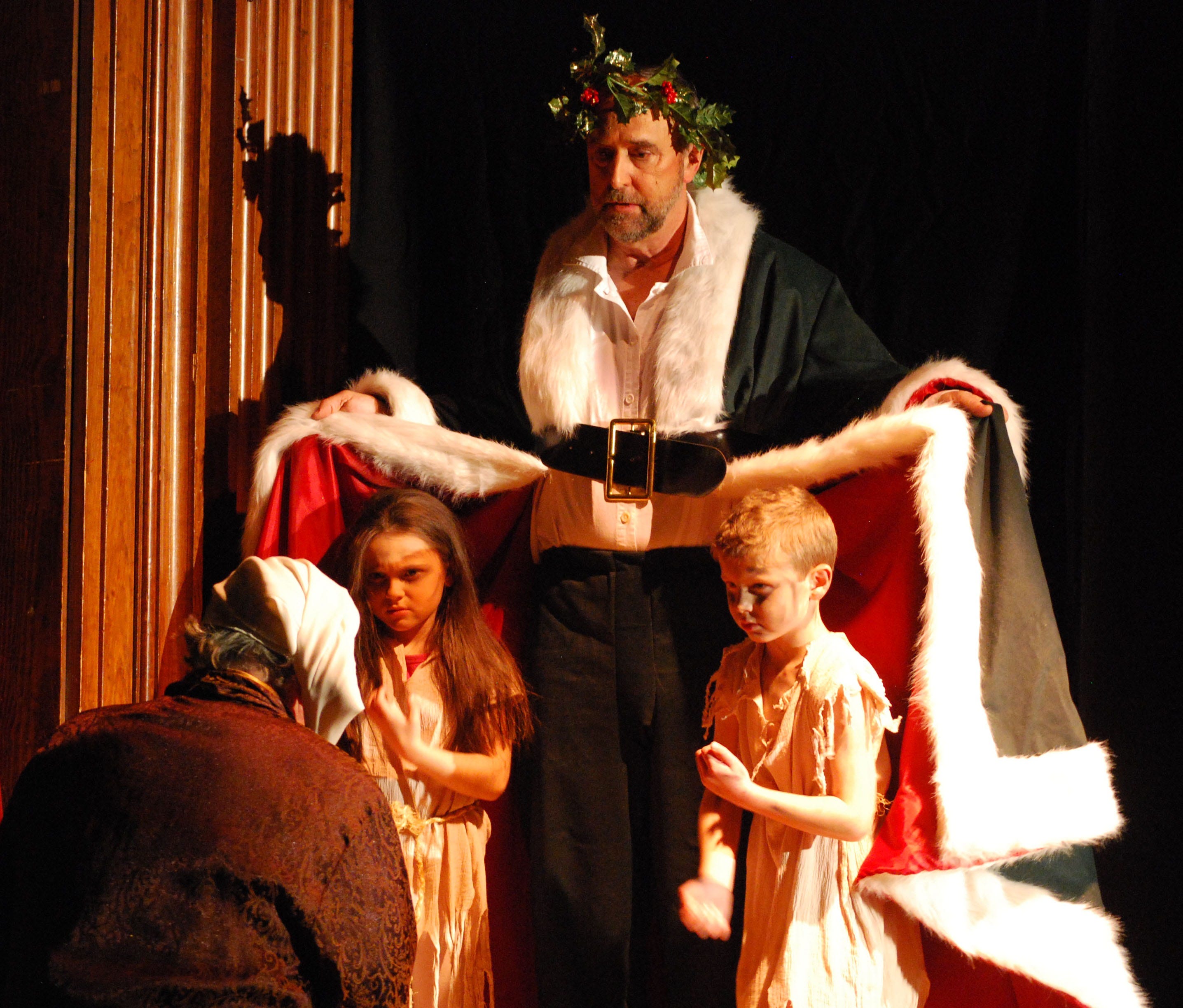
“They are Man’s,” said the Spirit, looking down upon them. “And they cling to me, appealing from their fathers. This boy is Ignorance. This girl is Want. Beware them both, and all of their degree, but most of all beware this boy, for on his brow I see that written which is Doom, unless the writing be erased. Deny it!” cried the Spirit, stretching out its hand towards the city. “Slander those who tell it ye. Admit it for your factious purposes, and make it worse. And abide the end.”
As readers might guess from the tone of my recent posts—my research has turned up some travel brochures for the Underworld. The Stygian Riviera. Downtown Carcosa. The suburbs of Hell. Hidden geographies that are hard to talk about at parties.
In addition to starting the engine on my book project, I’ve got a series of posts coming up in the new year: part self-diagnosis, part Unified Field Theory of how and why certain people get obsessed with secrets. There’s much to discuss about the relationships between various over- and underworlds, and the kind of people who find themselves commuting regularly between them.
Without getting too deep into it now—I think, on a fundamental level, we take for granted how subjective our experience of time can be, and to what extent the awareness of “the present” can differ among people.
A whole galaxy of personality quirks (including those often clinically misdiagnosed and poorly medicated) can be broadly understood in this way: some people experience the present as very dense—inarguably vivid, uncompromisingly solid—while others experience it as thin, malleable, and translucent, marbled with streaks of the past and the future.
Sometimes this is the result of trauma, when the past and the future are a refuge from the pain of the present. Sometimes it’s just a particular cocktail of brain chemistry. There’s no hierarchy of value in it. People who live with a more conditional present aren’t necessarily more perceptive than those who don’t; at least, not in a way that’s guaranteed to be useful.
For me, it’s a blessing and a curse. My own impressionistic present makes it almost impossible to take anything for granted. I can easily peer into the next-door multiverses in which I don’t have my health, my home, my family and friends in the way I do now. I can remember things that don’t exist yet, which can be a neat party trick for the right audience.
(Speaking of the right audience—thank you so much, as ever, to the people who have subscribed, shared, and started conversations around my work on Substack. I’m headed into my third year on here, which seems amazing, considering how… let’s say narrowly appealing my writing has been at times. I appreciate you all immensely, and am looking forward very much to doing more with this space in the coming year.)
On the flip side of that—the shadow side—a thin present makes it hard to ignore the subtle machinery always bumping and clanking away behind the scenes.
I imagine people who live in a reassuringly solid present don’t get obsessed with why the world is the way it is. It simply is. Thinking too much about how things could be deeply different feels both remote and pointless.
I’m envious of those people in the same way I’m envious of heavy sleepers. There’s a lot to miss out on when you’re not up and wandering the shadows at 3am—but you also wake up rested and ready to tackle the demands of the present, without wrestling the past and the future at the same time.
These questions are especially difficult when it comes to wondering why there’s so much darkness in the world.
Telling thin-present types to stop reading the news (or to turn off the paranormal/ parapolitics podcasts) is like telling your dog to ignore the fireworks on Independence Day. That goes double for parents anticipating a very near future in which they’ll have to explain All This Mess to their increasingly cognizant children.
Meanwhile, here in the present, it’s unavoidably Christmastime again.
The suggestion that we’re all equally capable of white-knuckling our way into holiday cheer has never sat well with me.
I wrote last year about the difficulty of staying with the spirit of the season when life refuses to play along. At that point, it was more about my own circumstances: losing my dad and the family that made my childhood Christmases so joyful. That was more Ghost of Christmas Past business. Unlike Scrooge, I didn’t lose that happiness out of miserly neglect. It got ripped away from me. So I was looking for the light in a much more personal way.
I’m in more of a Ghost of Christmas Present mood this year.
Here in the U.S., our public celebration of the holiday is all about the light. We try very hard to shape our version of Christmas into a continuity of an older tradition. We sing carols about the baby in the manger, the Star in the sky, the Three Wise Men. Our secular observances draw on the pagan symbolism of the winter solstice: we put out offerings for the fur-clad magic man who flies out of the arctic darkness, bringing gifts to leave beneath our evergreen shrines.
But in spite of this attempt at continuity—late-stage capitalism being what it is—Christmas has transformed into a fundamentally different thing. It’s now a mega-market for good vibes. Everybody wants the feasting and the toys and the candy-cane pop songs. They want store windows packed with fake snow, and tinsel, and sale-priced goodies. And they’re willing to pay handsomely for it.
Darkness doesn’t sell as well.
Modern Christmas is a fundamentally different thing, because the old holidays were a celebration of miracles. The light on its own is no miracle. There’s no need for Yuletide at the summer solstice, when the days stretch on and the crops are growing. But on the longest night of the year, when the ground is frozen and the wind is howling, light and warmth and food and shelter are miraculous. That’s what people were celebrating with the midwinter feast, not too long ago.
You can see the confusion when people bump into some of these older survivals in our contemporary celebrations. Listen to the lyrics of The Most Wonderful Time of the Year, playing in Wal-Marts across the country, with Andy Williams singing about the fun of “scary ghost stories” alongside marshmallows for toasting and caroling out in the snow. That song was written in 1963, so it’s hardly an ancient ballad; nevertheless, it describes a Christmas that incorporates darkness—a celebration inextricably tied to the darkest stretch of the dark half of the year.
Americans nowadays assume that “scary ghost stories” is just a reference to A Christmas Carol. But this gets it backward. Charles Dickens didn’t invent the idea of ghosts at Christmas as a nifty plot device for his morality tale. He was drawing from a long tradition of Yuletide ghost stories. These weren’t limited to festive tales with happy endings and a few incidental ghosts thrown in for spice, either. They were proper, terrifying, leave-the-bedside-light-on ghost stories. M.R. James, a world heavyweight in Gothic storytelling and an early pioneer of Weird Fiction, was carrying on the tradition well into the 20th century: many of his most famous (and thoroughly chilling) stories began as Christmas Eve entertainment for his friends and family.
In the era before central heating, stories around the fire were a major part of the season by necessity. Every step away from the hearth was a step toward hypothermia. The specter of frozen death was always lurking just outside the door. Ghost stories reflected that reality.
We can see that duality personified in Dickens’ portrayal of the Ghost of Christmas Present. Outwardly, he’s a Bacchanalian figure—a towering, bellowing, ambulatory punch bowl of hale-fellow-well-met exuberance. As a person, he’s the guy you either love or hate at the office Christmas party. But he also has a dark secret hidden under his robes, belying all that outward cheer: the skeletal figures of two children who represent the antithesis of holiday abundance. They’re also ghosts, but of a more familiar kind than the other “spirits” in the story. These are kids who died out in the cold. They haunt the figure of Christmas Present. Even while they’re hidden by his rich, festive trappings, they’re always with him, clinging on, clutching at him.
This trio of figures could be dismissed as a spectacle put on for Scrooge’s benefit. He’s a crotchety miser, the personification of greed; maybe the Ghost of Christmas Present scooped up his two confederates to teach this particular old bastard a lesson. Maybe they can be saved, or at least banished, if Scrooge changes his ways. They’re treated as self-contained within the story—an actualization of Scrooge’s earlier line of dialogue, about not bothering with charity as long as there are prisons and workhouses.
Maybe they’re not part of our Christmas Present. Because we’re good people, right?
“Deny it!” cried the Spirit, stretching out its hand towards the city. “Slander those who tell it ye. Admit it for your factious purposes, and make it worse. And abide the end.”
We can speculate about what kind of ignorance Dickens had in mind, when he named his harbinger of doom. Willful ignorance of the mere existence of poverty? Or ignorance of the sociopolitical machinery that creates beggars and refugees, forcing families into the cold without food or shelter?
Dickens may have been more socially progressive than his contemporaries. Even so—he was still a subject of Britannia. Like many liberals (past and present) Dickens could condemn “ignorance” by drawing attention to the unsightly excesses of poverty, without fully addressing the grim realities of an imperial system. An economy that depends on artificial scarcity will never eliminate poverty. Destitution doesn’t represent a simple lack of individual charity when it’s built into the architecture.
Covering up that reality is the kind of ignorance most people enjoy.
But, like all good prophecies, the Ghost’s warning transcends time, and place, and the intent of authorship.
Admit it for your factious purposes, and make it worse, and abide the end.
If we’re now ignoring that warning, in danger of making Christmas part of our factious purposes—keeping Ignorance and Want smothered under those heavy robes, so they don’t harsh our vibes—some of the blame belongs to Dr. Seuss.
How the Grinch Stole Christmas was written in 1957, when America was riding high on postwar triumphalism. We’d beaten the Nazis and knocked the Reds back on their heels in Korea. Eisenhower was in office. Elvis was in Graceland. There was trouble brewing in the American South—as well as some tinpot backwater called, what was it again, Viet-Nam?—but most Americans were feeling pretty good about themselves.
When Seuss’s story came out, readers had no trouble identifying with the Whos down in Whoville: kind, generous, warm-hearted people, who just wanted presents under the tree, stockings above the fireplace, and some roast beast on the table.
The Grinch, meanwhile, was the avatar for everyone who just couldn’t get with the global holiday program—a more abstracted version of Ebenezer Scrooge, without the flimsy justifications of balanced bookkeeping and the high price of coal. Why does the Grinch hate Christmas? Who knows! Shoes too tight, heart too small, some bullshit like that. Certainly not because of any rational or moral objections.1
Contrast the Grinch with one of his Germanic cousins: Krampus, another villainous monster who shows up at Christmas, coming out of the wilderness to terrorize the townsfolk.
Krampus serves an important mythic function: he’s a beastly Satanic figure (in the original sense) who preserves a sense of communal obligation toward the source of all gifts. If you’re a spoiled, troublesome, entitled kid who takes too much for granted—Krampus has a birch switch and burlap sack waiting for you. Adults who take too much for granted from the more-than-human world can expect a less cartoonish version of the same. Together, the pairing of the Saint and the Devil stand in for the dual nature of right relation with cosmic forces: gifts for the good, retribution for the bad.
The Grinch, meanwhile, is just being a dick.
Dr. Seuss (or his marketing team) saw the need for a bit of misdirection around the reason for the season. Seuss had Jewish ancestry, but grew up Lutheran. He didn’t have much personal stake in Christmas as a religious holiday. His publishers probably urged him toward something more universal.
Consequently, Seuss’s Christmas story is not just secular; it’s doggedly materialist. Santa Claus—one of the last magical figures still publicly recognized in American culture—only shows up as inspiration for a cheap disguise. When the Grinch has his climactic realization about Christmas as “a little bit more” than all the stuff he’s pilfered from Whoville—what exactly that “more” might be is left to the reader’s imagination.
How the Grinch Stole Christmas presents us with a completely ahistorical and self-justifying version of the holiday. What are the Whos celebrating down in Whoville? A vague appeal to fun, and singing, and togetherness, and… you know, a kind of generic Christmasness. They just want to have a party in the winter; the Grinch is trying to crash it because he’s a jealous troll. And They All Lived Happily Ever After, The End.
Just a kids’ book, maybe.
But the figure of the Grinch—at least here in America—has turned into a cultural shorthand for anyone threatening to upset the annual Good Vibes Bonanza.
Peace on Earth, Goodwill Toward Men, donating to charity, blah blah blah. That’s just the stuff we do in exchange for getting on Santa’s Nice List. Holding those ideals to a high moral standard is inappropriate at a time when Cindy Lou Who just wants to have fun.
To suggest that, maybe, there’s too much light in our winter solstice celebration—that our whole culture is turning into Clark Griswold’s house on a civilizational scale—is to risk being dismissed as a grumpy goblin who belongs in a cave, while everybody else sings Dahoo-Dores down below.
Would you believe, gentle reader—would you believe that, on more than one occasion, I have been accused of being a Grinch?
It’s a thankless job, but someone’s gotta do it.
In the kids’ book, the moral of the Grinch’s story is presented as a personal revelation, in the tradition of Ebenezer Scrooge: what if our myopic shortcomings keep us from enjoying the cultural juggernaut of Christmas, rolling on relentlessly without us? What if we throw open the shutters on the morning after our encounter with the ghosts, and the Dickensian street urchin tells us we have missed it? What if we don’t hear the singing in time, and let the sleighful of presents drop off the cliff of Mount Crumpit?
But the Grinch could ask, instead, alongside the Ghost of Christmas present and his spectral passengers: what if we’re already missing it?
If the Whos wake up on Christmas Day to a village full of empty houses, cold hearths, and the wind rushing down from the mountains—is it the Grinch’s fault for stealing all the presents? Or is it an inevitable consequence of taking the roast beast for granted, for ignoring the hermit out in the wilderness who lives in a past we’d rather forget? Is this what happens when we don’t leave out an offering for the Grinch, before he’s driven insane by the billionth reprise of All I Want For Christmas Is You? Before one more repetition of “I wish it could be Christmas every day,” as if there was nothing sacred about this specific time of year—this particular alchemy of light and darkness?
Monsters and ghosts aren’t easy company at the holidays. Nor are the thin-present people who can’t just pour themselves another cup of good cheer and stop thinking about the darkness waiting just outside the door. But we should at least try to invite them in, because they remind us what the reason for the season really is: the light is only miraculous when the world is as dark as it can get. The present is a flickering circle of warmth, circumscribed by some very cold shadows. And the things that live outside in the frostbitten wilderness don’t just ignore us because we choose to ignore them.
Somebody needs to keep an eye on those things—to hold the vigil on the longest night of the year.
At the very least, we can light a candle and leave out a plate of cookies for those who don’t come in from the cold, by necessity or by choice. Santa Claus isn’t the only shaman working late on Christmas, with his breath freezing in his beard, stumping through the snow under diamond-edged stars, bringing miracles to a darkened world. He’s a traveler outside of time, too—keeping the old magic kindled, carrying it into the present. We don’t get that magic without those who are willing to travel through darkness while the rest of us stay close to the fire.
And as somebody who’s spent a fair amount of time exploring the darkness these past few months, I can tell you: the magic of the glowing hearth is much more powerful when you finally come in from the cold, from a place where it’s impossible to take those things for granted.
Here’s wishing everyone warmth and light, health and happiness. Merry Christmas. See you in the new year.
In hindsight, we can see the Grinch as a prophetic figure: a hairy, cave-dwelling lunatic, piloting a vehicle at unsafe speeds, down out of the mountains, wanting to destroy the Whos’ way of life because he just… hates their freedoms…