

The End
A semiotic reconstruction focused on Othala, the twenty-fourth rune.

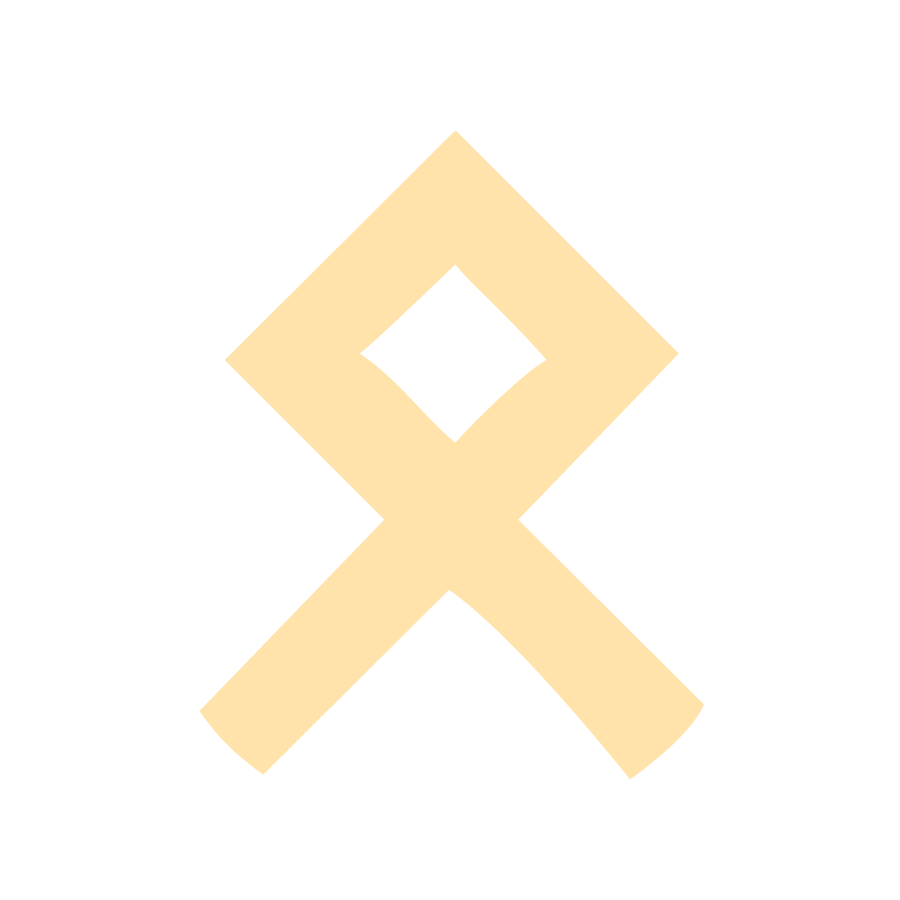
This is a supplement to the introductory video for Runeworld, posted on my Patreon.
The video described how a semiotic reconstruction—understanding and restoring the logic behind a particular system of symbols, not just reinterpreting the symbols themselves—might be one way to counter the appropriation of Norse culture by political extremists. A more specific description of how that looks when it’s applied to one specific symbol might help fill in the blanks.
The rune pictured above is Othala (or *Ōþala), the final rune in the twenty-four character Elder Futhark “alphabet” attributed to the Scandinavian and Germanic peoples.
Like all the runes in the Elder Futhark, its name is reconstructed from a rune-poem: a short, gnomic verse that links the symbol to a significant world-condition. In this case, the reconstructed Germanic word, “Othala,” is associated with inheritance, security, and generational succession.
Unfortunately, Othala was one of the symbols appropriated by the Nazis in the 1940s—specifically by several SS paramilitary units. In recent years, it seems to have become the preferred alternative to the swastika for Neo-Nazi political groups. It is now considered a “Nazi symbol.”
The Wikipedia entry for Othala provides a concise example of attempted academic suppression at work, in response to this appropriation:
“White supremacists who use the rune often claim it symbolizes the heritage or land of ‘white’ or ‘Aryan’ people which should be free from foreigners. Usages such as these are not attested in any source from before the modern period, being invented by members of these groups.” (Emphasis mine.)
The line that these interpretations “are not attested to in any source from before the modern period” is the boilerplate dismissal for any interpretation deemed to be the “wrong” kind of speculative association.
In academia, dismissing a conclusion as “unattested by an authentic source” is damning; when dealing with political extremists, it’s bringing a water pistol to a gunfight.
This type of academic suppression seems ineffective. What else can be done?
Arguing that Othala should represent homeland, inheritance, and generational succession, except in a non-racist way, is more straightforward.
It’s also too simplistic.
If we treat this one glyph as a discrete symbol, with the progressives arguing for one interpretation and the fascists arguing for the opposite—two competing symbolic revisions—there will be no resolution. Unless Odin comes down from Asgard and settles the argument once and for all, there is no definitive proof saying that either interpretation is objectively correct. And the progressives are at an extreme disadvantage here: while both sides have their own preferred interpretation, only one side is willing to support their views with actual violence.
So academic suppression doesn’t work; nor does countering one symbolic revision with another. Looking at the semiotic logic of the entire system might offer more leverage.
There are three necessary qualities that make Othala appealing as a symbol for fascists:
It must mean “homeland” or “lineage” as a definite space (either geographical, biological, or both) that can be owned.
It must be inherently positive.
It must be indefinitely sustainable.
I’m not a Neo-Nazi, so I have to guess at what they find appealing about the symbol1. But it seems like anything other than this narrow interpretation would discredit the associations they’re trying to make.
If we’re doing a semiotic reconstruction of Othala, we’re not looking only at what the rune means in isolation. We’re also not saying “no sources attest to these interpretations” as a blanket dismissal. Instead, we’re looking at how the complete semiotic system functions, with Othala as one necessary component.
Setting aside the obvious biological absurdity and moral repugnance of “racial purity,” we’ll evaluate each of the necessary qualities for the fascist interpretation in turn.
Does Othala mean “homeland” or “lineage” as a definite space?
Answering this question is the closest to a subjective interpretation, because so much of the historical record is reconstructed. We don’t know exactly what the original creators intended Othala to mean. Although we have clues from the rune-poem and the etymology of the rune-word to make some guesses, we can’t definitively state a “correct” meaning that would invalidate the fascist “blood and soil” interpretation.
What we can say with more confidence is this: it would be a major oversimplification to say that any of the Elder Futhark runes (including Othala) exclusively represent fixed objects.
The naive interpretation of the relationship between the runes and the names derived from the rune-poems is a simple correspondence between a symbol and an object. When combined with attempts to discourage misappropriation, academic conservatism pushes us toward these simplistic interpretations. Supposedly, the rune-poems use the same crude, “A is for apple” mnemonics that would be familiar to a five-year-old learning the Latin alphabet2.
Thus, we get this logic for Othala: the runes refer to objects; therefore, the object to which Othala refers must be “homeland” as a definite space, in the same way that Ehwaz (ᛖ) must mean “horse” as the actual, four-legged animal. (It doesn’t.)
This is, again, a major oversimplification.
Based on a close reading of the rune-poems—the main source of association between the runes and the “words” they’re understood to represent—the verses are very concerned with relationality, and what could be broadly defined as world-conditions. Othala is no different.
Here’s the reconstructed Old English rune-poem for Othala:
Eþel’ bẏþ oferleof æghƿẏlcum men,
gif he mot ðær rihtes and gerẏsena on
brucan on bolde bleadum oftast.
And one possible English translation:
Ancestral ground is held most dear—
but only where one may rightly dwell within it;
then the house becomes a place of recurring flourishing.
Based on this translation, there is no reason to think that Othala functions as a container in the way that the fascist interpretation requires.
Gif is the crucial word in the poem. It makes Othala conditional: “the house becomes a place of flourishing only if one may rightly dwell within it.” Rihtes and gerẏsena are conditions of ethical alignment. There is no sense of entitlement here. Othala is a site of obligation. More to the point—“he mot… on brucan” is also a conditional statement. “He may… make use of” suggests that the occupant does not possess the land indefinitely: his rightful, temporary occupation depends on both his stewardship and his ethical conduct.
This by itself doesn’t completely invalidate the fascist interpretation. At a stretch, a determined opponent could argue that the multicultural occupants of the “ancestral land” are using it in a way that disregards rihtes and gerẏsena, and that the “rightful” (presumably nationalist) inheritors of the land are being denied their proper place.
But the conditions attached to Othala would mean that the disputants must prove their case in order to determine gif he mot ðær rihtes and gerẏsena on brucan. Nothing in Othala suggests a clear justification for violence; neither does it support an argument for entitlement on the basis of some imagined heritage. Othala must be earned, through moral and ethical conduct; rihtes and gerẏsena require recognition within a community, in order to be valid. This is a matter of jurisprudence that depends on argument, proof, and justification in order to resolve.
This sense of obligation, relationality, and temporary conditions is consistent with both the whole corpus of rune-poems, as well as the Norse myths—which puts the fascist interpretation at odds with the semiotic system they’re trying to appropriate.
Is Othala inherently positive?
It should be clear from the conditional construction of the rune-poem that Othala is not an object with inherent qualities. This is also consistent with the corpus of rune-poems: in general, the rune-poems diligently preserve the ambiguous or contradictory tendencies of the conditions they describe.
For example—Fehu (ᚠ) is commonly associated with “wealth.” Wealth could be seen as straightforwardly positive. However, the Icelandic and Norwegian versions of the Fehu rune-poem both describe it as “the strife of kin.” According to the rune-poems, even something as vital for survival as “wealth” could have enduring negative consequences if handled badly.
With this duality in mind, when it comes to Othala, a better question is this: what happens if the moral and ethical obligations described in the rune-poem are not met? What does Othala become, if the flourishing of the ancestral homeland curdles as a result of the occupants’ mismanagement or misconduct?
The flourishing of Othala—its productivity, the sustainability of surplus value—is dependent on rihtes and gerẏsena. If the occupants of the “ancestral lands” don’t uphold their ethical obligations, the sustainable productivity of bleadum turns into unfulfilled obligation.
It becomes debt.
This is what is passed on to future generations. Fallow fields. Crumbling structures. Unpaid dues. Contested ownership.
For present occupants, the burdens of unfulfilled obligations are punishment for bad conduct. For those who inherit Othala under these conditions, the “ancestral lands” are a millstone hung around their necks: the sins of the father, passed on to those who had no say in the matter. While it’s possible to pay off the debts, fulfill the unmet obligations, and restore integrity to a blighted Othala—it puts the inheritors under an immediate burden, while also constraining their capacity to fulfill their own obligations.
This is how families fall into ruin.
So this second dimension of Othala throws another challenge at the people who would use it as a banner. First, can you prove your lawful and rightful title to the “ancestral land” you say is yours? Second—if you disregard rihtes and gerẏsena, and choose to occupy the land unlawfully—what poisoned chalice are you passing on to your children? What legacy of violence, dishonor, and barrenness are you leaving for those who follow after you?
The short-term victory might be worth the price for the usurpers. But what debts follow those who weren’t asked to accept the costs?
Can Othala be sustained indefinitely?
Ironically, this is where the mainstream interpretation might actually be helping the fascists.
If the complete Elder Futhark row is simply an assemblage of twenty-four phonetic symbols—”just letters,” as the academic conservatives claim—then the final character in the sequence has some inherently symbolic qualities.
This association is so common in the Latin alphabet that we almost take it for granted. “A to Z” is an expression of completeness. It’s even sacralized in the Bible (Revelation 22:13) where Christ identifies himself as “the Alpha and Omega, the beginning and the end, the first and the last.” Across the literate Mediterranean cultures, the first letter is connected with the cosmic Beginning (“In the beginning was the Word, בְּרֵאשִׁית בָּרָא אֱלֹהִים אֵת הַשָּׁמַיִם וְאֵת הָאָרֶץ”) and the last letter is linked with completion. Here, eschatology intersects with the supposedly mundane nature of the phonetic alphabet. The entire alphabet has a telos: the letters are building to a cosmic conclusion, with a full range of possibilities expressed along the way.
It’s unlikely that Othala’s position at the end of the Elder Futhark escaped the notice of the fascists. Not only is Othala (supposedly) compatible with the nationalist project; as the last rune in the row, it also represents a conceptual endpoint—a goal, a conclusion, a final state.
In this reading, Othala becomes a potential utopia: if the ends (or the End) justifies the means, then the fascists only need to fight long enough and hard enough against their opponents to achieve their goals. Othala can be achieved and sustained through continued radicalization and determined political violence.
But does the original semiotic system actually support this?
No.
The reasons why are complicated, beyond the scope of a single essay. The book I’m writing will develop this more fully. For now, we can say with some confidence that the Norse myths are consistently anti-utopian.
As mentioned in the presentation, even the sparse reconstructions we have of the Norse cosmology shows evidence of cyclical regeneration, rather than the definitive End Times prophesied in the Bible. It’s only in the Christianized translations of the Norse myths that Ragnarok is equivalent to Armageddon.
This is extremely significant.
If the alphabet is a microcosm of the world, and the world is understood to have a final End, then the last letter of the alphabet corresponds with that termination.
But if the end of one cycle marks the beginning of another—if the cosmos goes through successive transformations, never entirely ending—then the final letter in the alphabetic microcosm is a moment of transition.
In other words, Othala is not a cosmic finish line. These are not “ends justify the means” conditions.
Unlike the apocalyptic religions obsessed with battering the world into their desired form before the clock runs out, saving souls and burning heretics, there is much more emphasis on reconstruction in the Norse myths.
Ragnarok is inevitable, true. Not even the gods can stop in. The Great Darkening is fated to take place, it spite of Odin’s obsession with gathering knowledge about the world-conditions that will bring it about.
But then the world comes back.
After Ragnarok, the world rises from the sea once more. The Just Gods—the Aesir—gather in the green fields again. Not only do the survivors of the struggle against Fenrir and Surtr return to the world; some of the gods killed in battle come back as well.
The world starts up again.
From this perspective, Othala does not represent a guarantee against Ragnarok. At best, it’s a means of buying more time before the inevitable end of the previous cycle, before a new cycle begins. It’s a way of building resilient, inter-generational communities; of having something left in the ruins to rebuild.
Is the project of constructing a racially purified utopia aligned with these goals—assuming such a thing would even be possible?
No.
Nobody builds resilience by persecuting their neighbors, ignoring rihtes and gerẏsena, and wasting resources on a campaign of aesthetic whitewashing. The logic of racial supremacy and utopian idealism is the antithesis of the semiotic system that the Elder Futhark represents. The meaning of Othala can’t be understood separately from this logic.
Does this mean we should try to prevent the fascists from using Othala as their symbol?
Absolutely not.
On the contrary: we should encourage them to use it at every possible opportunity.
Because in the context they’re using it, with the proper understanding, it lands like a curse.
Othala represents the forces that will inevitably destroy them.
It stands for the antisocial, unlawful rottenness that will eat away at everything they’ve built.
It’s the black hole of malice that will swallow everything they claim to care about, everything they’ve ever loved.
It’s the myopic, self-serving waste and spoilage that will hobble their families for generations—the wreckage that their children and grandchildren will have to clean up, while spitting their names into the dust.
That’s the Othala they’re building.
And when this cosmic cycle ends, as it always does, their version of Othala will be scattered to the wind. Their homeland has no foundation in rihtes and gerẏsena. It offers no relational flourishing that will last.
It will be a wasteland.
They’ve picked an appropriate banner, and they’re dooming themselves by not understanding its cosmic significance.
This type of semiotic reconstruction allows us to see the absurdity of their symbolic revision, without getting stuck in pointless arguments about what we’d prefer the symbol to represent, or who it authentically belongs to, or whether their interpretations are “attested by any sources before the modern era.”
It also gives us a way to think about what it would mean to do something different and better.
If we’re opposed to their version of Othala, are we building another kind of Othala that’s more robust and sustainable—something more aligned with the cosmic cycles described by the myths and encoded in these semiotic systems?
Or are we just making the same mistake in a different way?
These are the kinds of questions these semiotic systems allow us to ask and answer in useful ways, because the people who originally designed them were trying to solve the same problems.
This is also why the potentially massive time depths plumbed by the oral traditions of elder cultures are more than just historical curiosities. If your culture preserves memories that stretch back thousands of years—maybe tens of thousands of years—that represents a huge amount of comparative data about how the world unfolds.
If that data can be indexed and cross-referenced through a reliable set of systematized memories, it becomes a kind of algorithm: “how has this happened in the past, and how might we expect it to happen again?” If myths and their adjacent semiotic systems (like, perhaps, the Elder Futhark runes) represent exactly this type of system—and I believe they do—then they aren’t simply recording memories of “the past.” They’re describing something about the world we live in now, about the contours of possible futures we should anticipate.
We should look for those mythic echoes in Othala, and in the complete semiotic system of which it is an integral part.
And we only get there by taking these things seriously as living systems.
That’s the goal of a proper semiotic reconstruction.
I could have done more primary-source research into how Neo-Nazi groups use these symbols, but then my browser history would be permanently screwed. Don’t want to get myself on a watch list and end up with a job recruiter for ICE knocking on my door.
This is one of the central mysteries ignored by the mainstream interpretation of the runes: the rune poems are terrible mnemonic devices, if they're meant to intuitively connect a phonetic sound with a memory aid. Either they were invented by sadists who were deliberately trying to confuse their students—or the rune-poems are serving a completely different function.
This is good work you're doing, Ryan! Found myself thinking of you the other day, as I suddenly realised how close to home your rune project comes. We were out at an old house in the middle of a swamp, a couple of miles outside of town, a dozen of us gathered for a skillshare around pruning apple trees. Over tea in the kitchen afterwards, someone mentioned an undocumented runestone in the garden, its provenance yet to be established. And someone else said, "Ah, well, you know the one by the Kartan turning, back in town? It's one of those nonsense stones, where they just put any old runes, without making any actual words." You can imagine my ears pricked up at that. The stone in question is not 200 yards from the front door of the shoe shop. I shall have to investigate further. But it gave me pause to realise, I've kept an eye on your project, yet without really thinking about how local it is to my corner of the world.