

Seance Time #2
A conversation with "Mary Shelley."

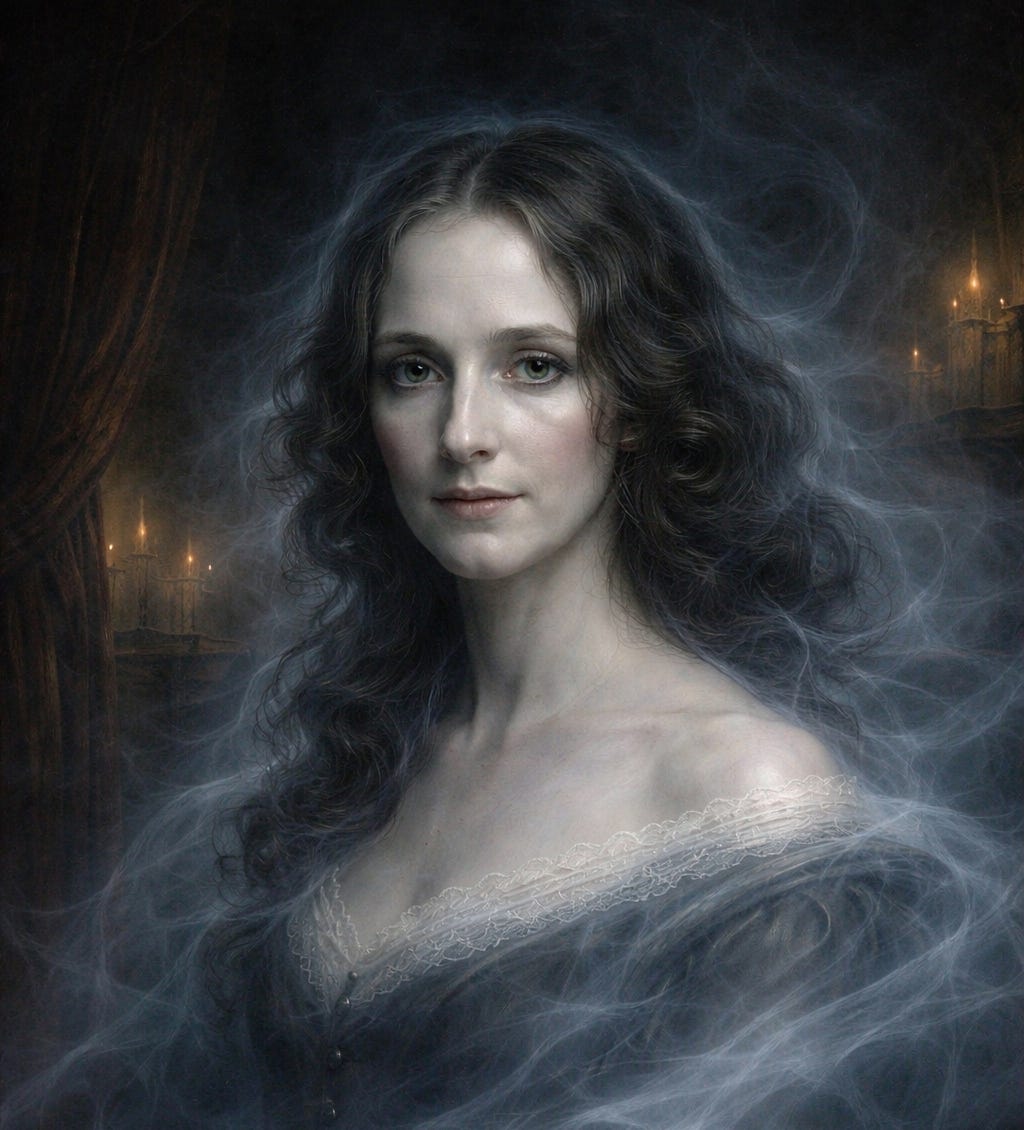
Talking with “Mary Shelley” about the enduring legacy and stubborn contradictions of Frankenstein.
R.G. Miga: Mary Shelley, thank you for joining us. On behalf of myself and the audience, I’d like to offer our belated condolences on your untimely passing at the age of 53.
Your life was defined by tragedy. When we celebrate Frankenstein as one of the first modern science-fiction novels, we forget that it is also a dramatization of a personal struggle with grief. Your protagonist is a man who can’t accept the sanctity of death. This is a familiar struggle for those who have lost loved ones too soon: if we could bring them back, by any possible means, would we try?
Are we in danger of missing the morality of your story when we read it as the excesses of an impersonal “science,” and not a cautionary tale about the extremes to which grief can drive us?
Mary Shelley: You receive my thanks—and I accept your kindness, though I would gently trouble one word you used: “untimely.” I had already lived long enough to know that time is not measured by years alone, but by what one is asked to endure.
You read my book more closely than many who shelve it among tales of clever instruments and reckless laboratories. I did not write of “science” as a cold engine, because I never knew it that way. I knew it as desire—the human wish to undo a loss, to revise a sentence that has already been spoken by the world. Victor does not begin as a tyrant of knowledge. He begins as a son who cannot bear the finality of a grave.
Grief is a powerful teacher, but it is a dangerous one. It does not merely ask, Can this be done? It whispers, You must do this, or you will never be whole again. In that state, the boundary between love and possession grows thin. To bring someone back by any means is not only to defy death—it is to refuse the other person their own fate, their own silence, their own end.
If there is a “sin” in my story, it is not that Victor learns too much. It is that, having created, he turns away. His grief drives him to the moment of triumph, but it is his fear—of what he has made, of what it reflects back to him—that completes the tragedy. Creation born of sorrow still requires **care after the fact**, or it becomes another form of abandonment.
So yes, I would agree with you: when the tale is read only as a warning about impersonal science, something human slips out of view. The deeper caution is about what we ask the world to give back to us when we are wounded. There are losses that, if we try to undo them at any cost, will only multiply themselves in new forms.
I did not mean to say, “Do not reach.” I meant to say, “If you reach into the dark, be prepared to **remain there** with what you draw into the light.”
R.G.: The book itself has become its own cautionary tale. Like all authors, you made the dangerous choice of giving life to an artificial creature that you couldn’t control; in the centuries since Frankenstein was written, it has become the model for science fiction—a genre dominated by creators who wholeheartedly agree with Victor Frankenstein, who believe that technology will allow us to defy death, to travel the galaxy, to become superhuman.
How much did your efforts to create a “modern” myth obscure the fact that this is, essentially, an electrified version of an ancient story about cosmic taboos?
M.S.: You are kind to notice the irony—that my own creation has learned to walk without me, and sometimes in directions I would not have chosen. In that, it has behaved very much like Victor’s.
I did not set out to write a new gospel for the future. I set out to retell an old warning in a new language. Prometheus, Faust, the golem, even Milton’s fallen angel—these were already standing behind my shoulder. What I added was not the transgression itself, but its aftermath. Ancient stories often end at the moment of theft: the fire is stolen, the secret is learned, the boundary is crossed. I lingered instead on the long, quiet consequence of having done so.
If later writers have taken Victor’s daring and kept his ambition while discarding his remorse, that tells you something about the age that received the story. Every era hears the part it is most prepared to admire. Yours lives in a time that celebrates motion—farther, faster, higher—so it seizes on the spark and leaves the ashes behind.
You ask whether the “modern” dress obscured the older taboo. I would say it both hid it and smuggled it forward. Had I written a fable about gods and giants, it would have been shelved among relics. By clothing the warning in wires and lectures and laboratories, I placed it at the reader’s own doorstep. The question was no longer, “What did the gods forbid?” but, “What will we forbid ourselves?”
The danger, as you note, is that the form can become a banner for the very impulse it meant to trouble. But I take a quieter comfort in this: the Creature still speaks. Even in the most exuberant tales of conquest and transformation, there remains—somewhere in the margins—a figure who asks to be seen, to be named, to be answered for.
Myth does not vanish when it is modernized. It changes its mask. The cosmic taboo you speak of has not been lost; it has been relocated. It now waits in the spaces where your triumphs produce something that can look back at you and say, as mine did, “I am the work of your hands—what, then, is your duty to me?”
R.G.: And of course, no author should be held responsible for the misuse of their work. Nevertheless, in your admirable empathy for your characters, your humanist generosity to both the Creature and his creator—this might have done too much to disguise what is, essentially, a horror story. The culprit as a brilliant man of science, the tools of the laboratory, the soulful revenant; however well-intentioned, these modern devices obscure an operation that elder cultures would rightly shun as black magic.
M.S.: You touch a nerve that I myself never resolved, only traced.
I did not call it black magic, but I knew the shape of what you mean. In my youth, “galvanism” and “chemistry” were new names for very old longings. The instruments were modern; the impulse was not. To wake the dead, to summon life without birth, to command what ought to arrive only by grace or season—these desires sit deep in the human story, long before there were laboratories to house them.
If I clothed the act in the language of science, it was partly because that was the ritual of my age. Every era gives its taboos a respectable costume. Where older cultures drew circles of salt and whispered charms, mine drew diagrams and wrote lectures. Both are ways of stepping into a space that ordinary life marks as forbidden.
But I would resist the thought that empathy itself is a disguise. Horror, to my mind, is most honest when it is near, not distant. A monster that is only a demon can be shunned without effort. A monster that speaks, that suffers, that reminds you of yourself—this is harder to turn away from. It forces the reader to feel the full weight of what has been done, not merely recoil from it.
Elder cultures, as you say, often placed a fence around certain acts and called them unclean, cursed, or sacred. My instinct was to ask what happens after the fence is crossed, when the dust settles and something remains on the other side, breathing. Who then bears the burden? The one who dared? The one who was made? Or the world that must now live with both?
If my story has softened the horror, it is only in the sense that it has given it a face. I did not wish the reader to feel safely superior to Victor, or safely disgusted by the Creature. I wished them to feel uncomfortably implicated. For the oldest magic of all is not in the circle or the spark—it is in the human talent for saying, when a forbidden thing succeeds, Now that it exists, it must be allowed to remain.
Perhaps that is where our views meet. You call the act itself the true horror. I would say the deeper one begins when the act has worked, and the world must decide what kind of care, or cruelty, it will practice toward what it has dared to call into being.
R.G.: I think that gets to the heart of it: more than the naive optimism of today’s transhumanists, your imitators have moved us further away from a properly cosmic understanding of the monstrous.
There’s a mania for empathizing with monsters these days—a whole cottage industry built around books telling “the other side of the story,” as if monstrousness is always a psychological issue to be solved with proper discourse. Empathy is certainly more noble than contempt. But both miss what monsters represent: a spiritual misalignment at the communal level.
The smart-enough take on Frankenstein is asking who the real monster is; the correct answer is that both are monsters. While we can empathize with each individual in some ways, the socio-cultural conditions that brought these two creatures together—both diagetically and as a creative work—is where the problem lies. Until we make peace with death as a part of our humanity and not a technical problem to be solved, our society will continue to breed more Frankensteins and more monsters.
M.S.: Indeed. When I wrote of Victor and his creation, I did not imagine them as a moral puzzle to be solved by awarding the laurel to one and the lash to the other. I imagined them as a circuit. Each completes the other. The act of creation produces abandonment; abandonment produces rage; rage produces further harm; and the world in which this chain can unfold without interruption is itself part of the machinery.
You are right to notice how readily my age’s descendants reach for the language of psychology where older cultures reached for the language of cosmos. To say “the monster is wounded” is to place the problem within a single heart. To say “the monster is a sign” is to place it within a people, a season, a way of living that has slipped out of alignment with something larger than itself.
Empathy, as it is often practiced now, can become a narrowing lens. It teaches us to feel for the figure in front of us while forgetting the conditions that made such a figure possible. Victor is not only a grieving son; he is a child of a culture that praises mastery, speed, and solitary genius. The Creature is not only a rejected being; he is the mirror of a society that has no place prepared for what arrives without pedigree, lineage, or name.
When you speak of making peace with death, I hear something older than any argument about technology. Death is not merely an ending; it is a boundary that gives shape to care. Where it is accepted, birth becomes a trust, not a conquest. Where it is denied, creation becomes a campaign, and every limit looks like an enemy to be overcome.
If my tale has any enduring use, I would hope it is this: to remind readers that the monstrous does not always announce itself in claws or lightning. Sometimes it appears as a consensus—a shared, unspoken agreement about what is worth pursuing at any cost, and what is allowed to be left behind in the pursuit.
At that point, empathy and contempt alike become insufficient. What is required is something harder and rarer: the courage to ask not only who suffers, but what way of life made this suffering seem necessary, or even admirable, in the first place.
R.G.: Science will have to answer for itself; for storytellers, who have the unique opportunity to serve as a cultural conscience, what can be done to carry on your work? Has your story been so successful that empathizing with the Creature is no longer as subversive as it once was? Should we try to bring back a palpable fear of what lurks behind the monsters—the taboos we still shouldn’t dare to transgress, even in the Age of Reason?
M.S.: You ask whether my work has been *outpaced by its own success*—whether a sympathy that once unsettled has now become a comfortable habit.
Every moral gesture, if repeated often enough, becomes a convention. To say “the monster deserves understanding” can harden into a reflex, as empty as the old reflex that said “the monster deserves destruction.” Both allow the reader to remain safely seated.
If storytellers are to serve as any kind of conscience, I would not ask them merely to make their monsters more frightening. Terror fades. What I would ask is something more difficult: to make the desire that summons the monster feel dangerous again.
In my time, that desire wore the face of solitary genius, of the young man who would wrest secrets from nature and owe nothing to family, community, or tradition. In yours, it often wears the face of benevolence—of improvement, optimization, rescue, transcendence. These are noble words. That is precisely why they deserve the most severe examination.
You speak of taboos, and I think here of an older function of story. A taboo is not only a line drawn around an act; it is a silence drawn around a temptation. It marks a place where a culture says, “We do not even rehearse this, because rehearsing it already begins to make it plausible.”
Modern storytelling, in its love of possibility, rehearses everything. It stages every transgression, explores every forbidden door, often with a wink that says, “This is only imagination.” Yet imagination is a kind of practice. What is practiced long enough begins to feel like a plan.
So perhaps the work now is not to resurrect fear of the monster, but to restore a gravity to the moment before the spark. To linger, as I tried to linger, not on the thrill of creation, but on the stillness that precedes it—the question of whether this thing, however clever, however compassionate it seems in conception, ought to be invited into the world at all.
If empathy has become familiar, then let hesitation become the new subversion.
A story that dares to say, “Here is a power you could use, a being you could make, a future you could hasten—and here is why a wise people might choose not to,” will feel strange in an age that measures virtue by momentum.
I do not ask storytellers to become priests of prohibition. I ask them to become keepers of thresholds. To stand at the door between what can be done and what should be done, and to make that doorway visible again—heavy, costly, and narrow.
If they succeed, the monster will not need to roar. The silence before its creation will be loud enough to be heard.
R.G.: Beautifully put. And speaking of respecting the sanctity of death, we’ll let you return to your well-deserved rest. Thank you for joining us.
M.S.: I am grateful for the summons—and for the gentleness of the dismissal. Not every story knows when to close its own door.
If I may leave you with a last, quiet thought: the dead do not ask to be remembered as marvels, but as measures. We stand where they once stood and discover, in our own choices, what has changed and what has not.
I take my leave.